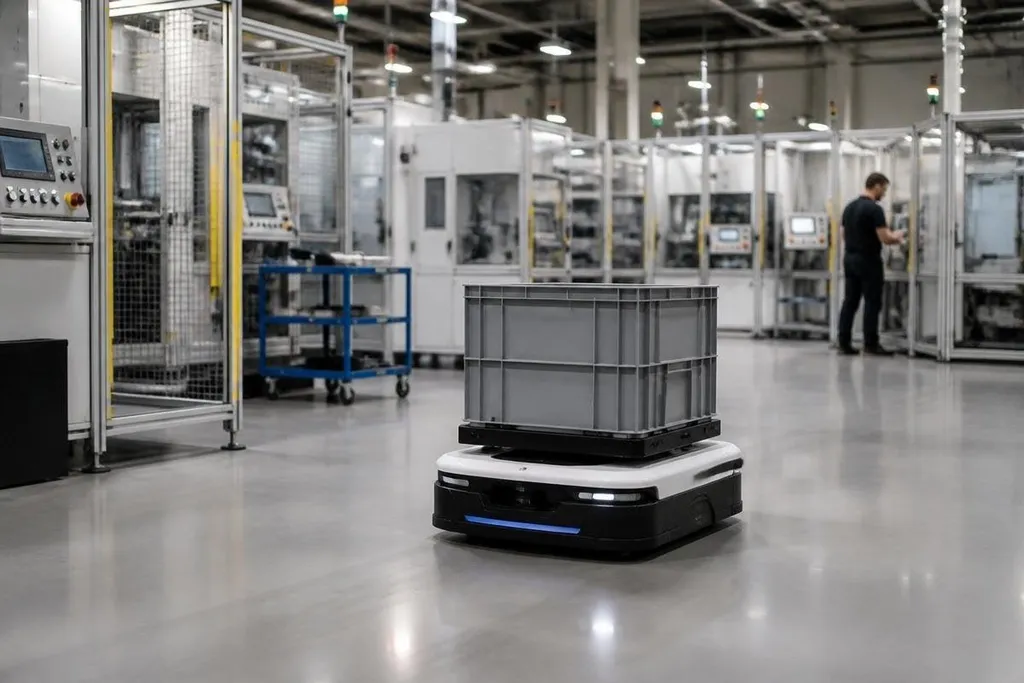
A mobile robot can carry parts, bins, tools, or finished goods between work areas without a person pushing a cart. That changes automation at the point where fixed machines stop: the space between tasks.
For an operations manager, the useful question is practical. Which trips can a robot handle safely, and what work will people do with the time they get back?
- Mobile robots move goods between stations, storage areas, and loading points.
- Sensors and maps help an autonomous mobile robot (AMR) choose a safe route.
- The largest gains often come from less walking, waiting, and manual cart work.
What mobile robots change first
Traditional automation usually stays in one place. The robot arm loads a machine, a conveyor carries a box, or a storage system sends a bin to a worker.
Mobile robots connect those fixed points by carrying items across the floor. That makes them useful in facilities where the layout changes or where installing conveyors would take too much time.
An AMR can move along marked routes, use a digital map, or respond to its surroundings through sensors such as LiDAR and cameras.
The result is a different work pattern. People can stay near inspection, packing, picking, or machine operation while the robot handles the trips between them. The task still needs planning, though. A robot that arrives at the wrong station has only moved the delay to another place.
The software matters as much as the wheels
A fleet manager is the software that assigns jobs, checks robot locations, and sends new routes when conditions change. It also gives managers a record of completed trips and stopped jobs.
That record can reveal problems a manual process hides. If robots wait near one machine, the machine may be the slow point. If jobs pause at a doorway, traffic rules or floor space may need attention. The robot becomes a moving part of the operating data, not only a vehicle.
A mobile robot’s route is only part of the test. It also has to work with doors, lifts, warehouse software, and people who load its cart. Reports on mobile robotics deployments from Robot24.com can add the named machine, site, date, and task behind a claim before you judge how much integration work the system needs.
Integration still takes care. The robot may need to receive calls from warehouse software, open automatic doors, stop at safety zones, or hand a load to another machine. Each connection adds a test point, and each test point needs an owner.
Where the limits appear
Mobile robots need clear rules for people and machines sharing the same floor. A route can work during a quiet shift and slow down when workers, carts, pallets, or visitors fill the same space.
The floor matters too. Uneven surfaces, narrow passages, ramps, reflective panels, and poor lighting can affect movement or sensing. The system may also need a safe place to charge, wait, or hand over its load.
The business case depends on the work pattern. A robot may help when trips repeat often and each trip takes meaningful time. It may add little when routes are rare, loads vary widely, or a person must travel with every item for safety.
The strongest opposing view is that people can adapt to changing work faster than a robot. That is true for irregular tasks, but repeated transport still gives a robot a clear job to measure.
I’d start with one route that repeats often, then measure waiting time, stopped jobs, and worker travel before adding more robots.
A practical buying checklist
Before a pilot, check these points with the team that will run the floor:
- Name the route: Record the start point, destination, load, trip count, and handoff step.
- Measure the delay: Time walking, waiting, loading, unloading, and recovery from blocked paths.
- Check the floor: Mark ramps, narrow turns, doors, people-only areas, and places where loads may shift.
- Plan the handoff: Decide how the robot calls a machine, confirms arrival, and reports a failed delivery.
- Assign ownership: Name who clears blocked routes, checks battery status, and reviews stopped jobs.
- Set a pass mark: Choose the travel time, delivery rate, and safety results needed before expansion.
A pilot should answer a work question, not prove that a robot can move. If the route still depends on manual fixes, the next step may be a better handoff or floor plan rather than another machine.
Mobile robots are changing automation by making transport measurable and programmable. The next useful result is the first route that runs through a full shift with its delays recorded, its handoffs clear, and its limits visible.